
Sight Unseen Reframed
Sight Unseen Reframed
Extra Content
Explore additional content related to the exhibition including Douglas McCulloh’s art and curatorial practice and work by the photographers featured in this exhibition.
Sight Unseen Reframed
Learn About
Douglas McCulloh
Douglas McCulloh was an artist, writer, and curator. He was senior curator and executive director of UCR ARTS until his untimely passing in the first days of 2025. He was an honors graduate of the University of California, Santa Barbara, and held an MFA in photography and digital media from Claremont Graduate University.
Parallel to his own art, McCulloh’s tenure as curator and director of UCR ARTS and the California Museum of Photography (CMP) shaped an entire regional discourse. He treated curating as an extension of creative inquiry — another system for generating connection and discovery. His exhibitions In the Sunshine of Neglect and Facing Fire and others exemplified his belief that photography is both mirror and instrument of civic consciousness.
At the CMP McCulloh championed Inland Southern California as a site of radical experiment, challenging the hegemony of Los Angeles proper. This curatorial vision mirrored his artistic one: the periphery as center, the overlooked as revelatory. McCulloh’s curatorial ethos — generous, restless, and humane — echoed the systems of his art: inclusive frameworks that made space for others to appear. His leadership transformed the institution into a forum for contemporary inquiry while honoring the region’s experimental lineage.
Over the course of his artistic and curatorial careers, his work was featured throughout the world and has been shown in hundreds of exhibitions nationally and internationally including Laguna Beach, Los Angeles, New Orleans, New York, San Francisco, Florida, Santa Fe, Washington, DC, Amsterdam, Barcelona, Beijing, Istanbul, Lausanne, London, Madrid, Mexico City, Milan, Paris, Portugal, Sardinia, and others.
McCulloh’s books include: Lost in the Wilderness: Ansel Adams in the 1960s; Facing Fire: Art, Wildfire, and the End of Nature in the New West; In the Sunshine of Neglect: Defining Photographs and Radical Experiments in Inland Southern California, 1950 to the Present; The Great Picture: Making the World’s Largest Photograph; Dream Street; Sight Unseen: International Photography by Blind Artists; On the Beach; The Edge of Air; and Chance Encounters.
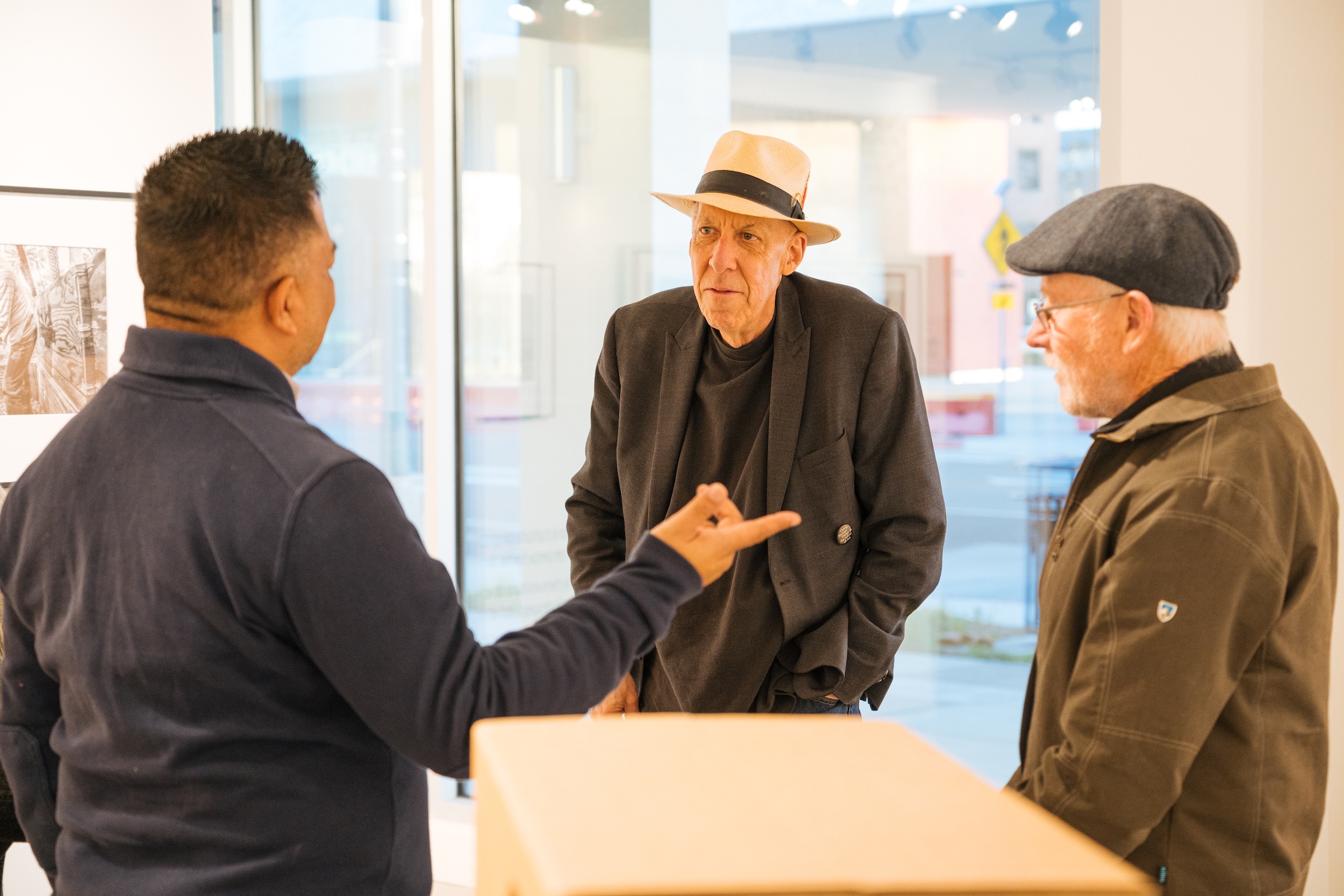
McCulloh co-curated The Civil Rights Institute’s second and third exhibitions, Working Coachella: Images of the Farmworker Community of the Coachella Valley and San Bernardino Photography Now: I’m Grateful Thorns Have Roses, and was a beloved member of The Civil Rights Institute team. Learn about the exhibition here.
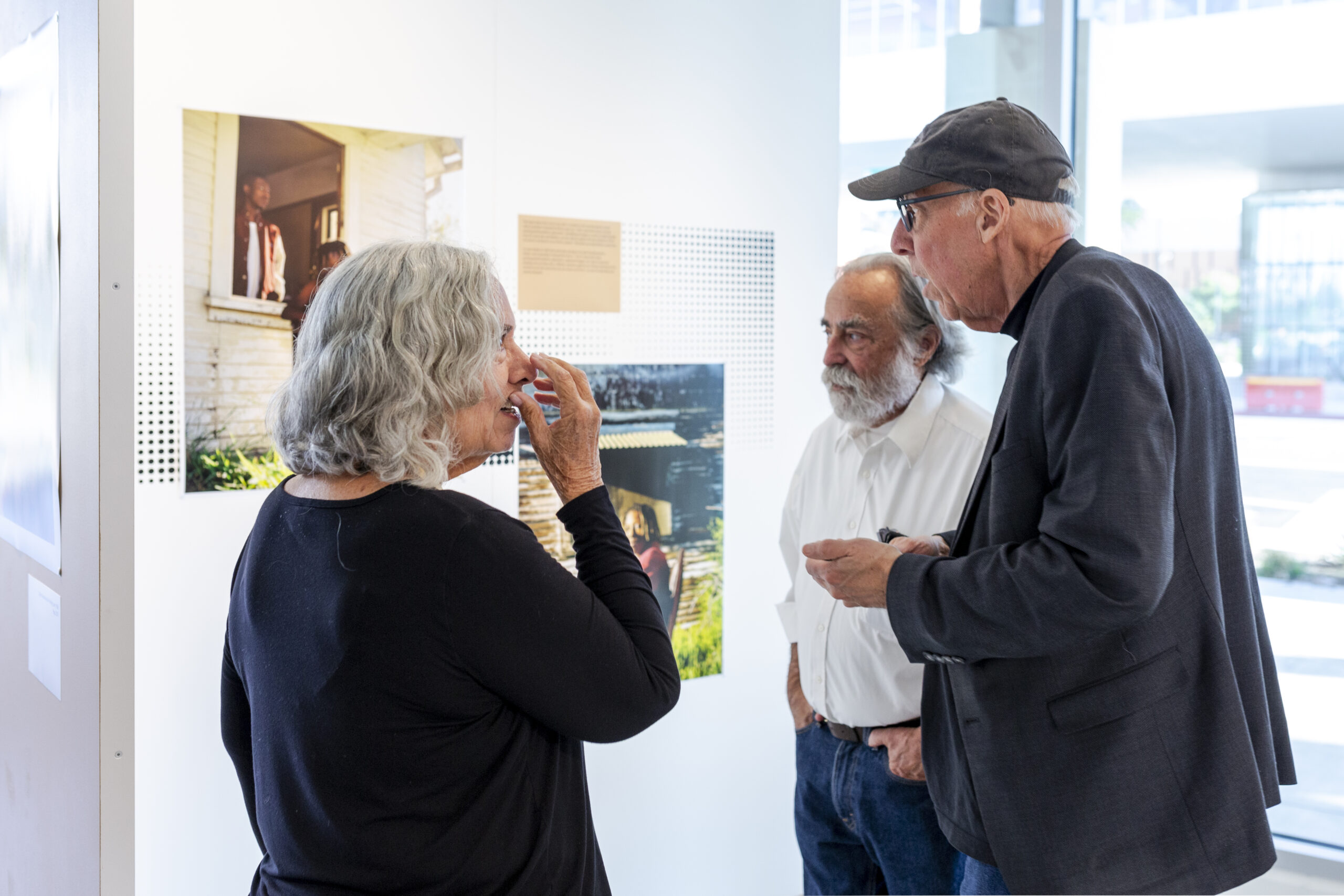
Visit
Dispatches at UCR ARTS
California Museum of Photography
September 12 to December 20, 2026
Dispatches: The Photography of Douglas McCulloh, 1990–2025 is the first survey of the breadth and full depth of Douglas McCulloh’s photographic work. This retrospective exhibition collects all of his major projects in extensive form and allows us to see the historical, conceptual, and cultural context of his singular vision and his achievements. From the expansive series Chance Encounters (1990–8), Lost Among the Stars (2003–6), American Cross (2013–25), and Dream Street (2000–9), to ground-breaking work with found imagery, internet archives, performative interventions, and the landmark project The Great Picture (2006); McCulloh’s naturally inquisitive intelligence and visual acumen is evident in his early projects and experiments right through to works made at the time of his passing in 2025.
Explore the Artists
Learn more about the artists featured in Sight Unseen
Henry Butler (1949 - 2018)
Listen to McCulloh read Butler’s biography
Transcript: Henry Butler, New Orleans. Henry Butler lives deep inside music, and—as with most musicians—the delight is in performance. He applies the same thinking to photography. “My thing is in taking the photograph, I love to capture the image. That feels good to me in the moment. Now I don’t always know exactly, literally, what I’ve captured.” “What you have to know about Henry,” says longtime assistant Andrea Duplessis, “is that he’s an extreme intellect. When he makes photographs, he reaches out with that intellect and combines it with instinct and intuition. His mind is what makes these photographs. I once saw somebody tell him, ‘You can’t know what red is because you can see.’ He told them, ‘I know what I perceive the color red to be, and you’re in exactly the same position.'” Butler is a classically trained musician with a percussive virtuoso piano style and eight WC Handy Blues Award nominations. He started playing keyboards at six and studied at the Louisiana State School for the Blind. Butler received formal music training at Southern and Michigan State Universities, earning a master’s degree. A grant from the National Endowment for the Arts allowed him to study with keyboard players George Duke, Cannonball Adderley’s Quintet, and the late Sir Roland Hannah. Butler’s early albums are jazz trio recordings with top flight instrumentalists Charlie Hayden, Billy Higgins, Ron Carter, and Jack Dijonette. Over the past decade, Butler increasingly has returned to New Orleans music and the blues. Butler’s photography began in 1984 when he sat for an extensive promotional photo shoot. By the end of the session, labored and seemingly eternal, he decided he could do a better job behind the camera. He’s been making photographs ever since, but not much intimidates the world-class musician with the glaucoma-clouded eyes and wraparound shades. “Shoot pool, throw darts, I’ve tried both.” As one might expect, much of Butler’s street photography is driven by sound. In these captured moments, we see audio cues taken, aural suggestions acted upon. Butler tours and shoots worldwide, but many of the New Orleans images are startlingly immediate portrayals of his hometown’s distinctive denizens. Off-center, vivid, and deliciously arbitrary, the photographs also speak to Butler’s gregarious, exploratory character. As experimental as these images are, Butler bases some of his photographic decisions on his long-term study of the foreign country of the sighted. Viewers need, quote, “What they call composition,” he says, “something in that shot that gives them sort of a home base, so they can identify and it makes it real for them,” end quote. Beyond that, Butler applies the ideas inherent in his music, “Be open, embrace variety and experiment relentlessly, then trust that your audience will come forward to meet you. No two people will see things in the exact same way. When I take a photograph, it’s a great learning process for me. Each person that describes it or looks at it has a totally different way of seeing it. People see colors differently. They see different things in that same picture. They interpret what they’re seeing based on their own intellect.”
Pete Eckert
Listen to McCulloh read Eckert’s biography
Transcript: “I slipped photos under the door from the world of the blind to be viewed in the light of the sighted.” To Eckart, blindness is his advantage. “Vision is so strong that it masks other senses, other abilities. It even overrides visualization. Sighted photographers always talk about the difficulty of what they call ‘seeing.’ I tell them, ‘If you can’t see, it’s because your vision is getting in the way.'” Eckert holds a degree in sculpture from the Art Institute of Boston and degrees in art and design from California State University, San Francisco, but it was only after he became completely blind in the mid-1980s that Eckert began to pursue photography. He started with a 1954 Kodak Retina 2A, a camera with infrared focus settings on the German-made lens. “I’m blind, so making photographs using a non-visible wavelength really appealed to me.” Eckert has an adventurous streak. He owns and occasionally rides a motorcycle and holds a first-degree black belt in Taekwondo. Street-wise and unafraid, Eckert undertook much of his early infrared shooting late at night in far-flung precincts of urban San Francisco. “The human brain is wired for optical input, for visualization,” says Eckert. “The optic nerve bundle is huge. Even with no input, or maybe especially with no input, the brain keeps creating images. I’m a very visual person; I just can’t see. Eckert considers his current mode of image-making “one-shot cinema.” The aim is to create open-ended narratives and capture them in a single frame. Eckert conjures up increasingly complex images and devises a way to shoot them on location, or more frequently, in the 30-foot deep studio he has built in his Sacramento backyard. He casts friends and neighbors and builds props. He sets up his Toyo 4×5 composite body view camera on a tripod. He notched the focus rail with set focus points using a diamond coated jewelry file. When all is ready, Eckert throws the switches that drop his studio into total darkness and opens the camera. Eckert roams the space and paints his image with light. “I use any light source I can understand.” His palette includes flashlights, candles, lasers, lighters, even black powder. The roving light is an uncanny substitute for the artist’s missing sight. The touch of the light sketches an image onto the film. Areas that the light misses remain blanks, darkness, unseen. Shutter open, Eckhart moves through the darkness, deploying his lights to build the image he sees in his mind. “Where I’m going is so different that I have to have a plan. I structure all my shoots the same way. I visualize, and then I adapt. I assume it will be about three quarters the way I planned and a quarter what happens. The photograph, of course, is a record of a scene before the camera,” but with Eckert it captures more, the artist’s gesture, the passage of time, the realization of a inner mode of seeing.
Bruce Hall
Listen to McCulloh read Bruce’s biography
Transcript: Bruce Hall, Irvine, California. Bruce Hall’s night sky was devoid of stars, a vast sheet of darkness. Hall was born with a word salad of eye conditions: nystagmus, myopia, astigmatism, amblyopia, macular degeneration, and exotropia. Quote: “I grew up hearing about stars, but I’d never seen them. When I was 9 or 10, a neighbor kid down the street let me look through his telescope. We pointed it at the North Star. It was like an opening into another world,” end quote. Hall saw not just stars, but possibilities. The childhood glimpse became a turning point, directing Hall into a lifelong engagement with seeing devices, cameras, lenses, magnifiers, telescopes, computer screens. Since then, Bruce Hall has constructed his world from photographs. When he looks into your eyes, it’ll be on his 40-inch Sony high-definition monitor. Most photographers see in order to photograph; Bruce Hall photographs in order to see. Hall is one of four artists in the exhibition who, while legally blind, retain some limited, highly attenuated sight. “I think all photographers take pictures in order to see, but for me it’s a necessity. I can’t see without optical devices, cameras. Therefore, it’s become an obsession. It’s beyond being in love with cameras. I need cameras.” Susan Sontag called photographs objects, quote, “that make up and thicken the environment we recognize as modern,” end quote. By this logic, Hall leads a hyper-modern life, employing an ever-present camera to build his visual world one photograph at a time. Hall calls his device-enabled interface with the world “intensified seeing.” The devices are extensions, amplifications of his body. Quote: “Without cameras my life would be bleak. With cameras, I can see. The result is a strange form of double vision. I always see things twice. First I see an impression. I take what I think I see. Later I can say what I saw. I have certain aims, guesses, impressions, but the photographs are always a surprise.” This exhibition features photographs from two Hall’s most extended projects: underwater photography and an ongoing engagement with James and Jack, his profoundly autistic twins. The subsurface and autistic worlds are essentially beyond reach. One can visit, gather glimpses and impressions, but it is impossible to truly inhabit either space that Hall now concentrates his photography on these two subjects comes as no surprise. After all, he has spent a lifetime using a camera to visit a foreign world, everyday life.
Annie Hesse
Listen to McCulloh read Hesse’s biography
Transcript: Annie Hesse, Paris. Annie Hesse is restless. She has lived in California, Guatemala, southern Spain, Crete, Cairo, Africa, London, and Paris. A camera has accompanied her since she was a kid. “The world spins by awfully fast and I obviously have a craving to soak it all up. With my vision the way it is, I can’t absorb it, so the camera does it for me,” end quote. In a famous essay, Walter Benjamin describes the flaneur as the characteristic observer of the modern age. Hess is the quintessential “flaneur”: “someone who walks the streets in order to experience them.” To Benjamin, this perspective of constant motion offers the only chance to decipher the current contradictions of order and chaos and resolve modern dislocations. Hesse’s photography began with a degree from the San Francisco Art Institute, slightly better sight, in a fast-moving career as a punk rock photographer/participant in Northern California and London from 1978 to 1982. Her early black and white work is studded with punk luminaries Iggy Pop, Fast Floyd, Susie and the Banshees, The Clash, The Avengers, The Sirens, The Victims, The Dreamists, The Offs with Snooki Tate. The images look like someone who can’t see haul the camera into a brawl, and that’s pretty close to the truth. By now, Hesse describes herself as a citizen of the world. She once hopped a Yugoslavian freighter from New Orleans to Casablanca with an unsteady boyfriend. Their messy breakup occurred mid-Atlantic. She spent a year hitchhiking throughout Africa and lived on Crete for seven years. Except for a short stint in Bellevue, Washington, working for Microsoft, she has been based in Paris since 1985. Describing the vision of the legally blind is a treacherously hazy business. Hesse says she sees, quote, “rough impressions like Matisse at his vaguest,” end quote, and only with her right eye. With only an impression to go on, she makes photographs based on hunch, conjecture, and curiosity, and she does so in the tumult of near ceaseless travel. Quote: “In the chaos of a foreign place I might be attracted to something about the color or the sound or vague forms. I’ll be right in front of it and not know what it is, so I’ll capture it. Later I used the picture to figure out what it was that I saw. Photographically enabled vision is a condition of the modern world. The frozen drop of milk, the fetus glowing in the womb, the mushroom cloud over Hiroshima.” But Hesse has built her entire visual world piece by piece from her own photographs. Her memory is the camera’s memory. Quote: “For someone who’s been visually impaired all my life, I’m extremely visually oriented. Photography has created my world. It stops time, and I absorb it later.”
Michael Richard (1948 - 2006)
Listen to McCulloh read Michael’s biography
Transcript: Michael Richard’s photographs are exercises in highly concentrated seeing by an artist whose sight was on the edge of slipping away. Richard’s photographs, thousands of them, were produced in intense four-year burst following January 2002 when a malignant tumor was removed from behind his eyes. The operation left him with vision, quote, “like the most extreme soft focus photo you can imagine,” he said. That August, at age 54, he enrolled in a photography class at Braille Institute in Los Angeles, taught by former Life magazine photographer, Jack Burns. Richard said he expected a lecture class, but was instead handed a camera. Richard’s photographs are full of unlikely discoveries, uncanny geometric balances, formal views given a twist, and small details very deliberately seen. For Richard, a grand vista across Yosemite Valley would be a cipher. He could find the entire world in a puddle in a parking garage. This was his mode. Put on his dark glasses, hang a powerful magnifier on a string around his neck, and haunt a few square blocks of urban Los Angeles. He would often spend days very deliberately looking, observing, noticing, then looking once more, returning, circling, and scrutinizing yet again. Richard subscribed to the dictum of landscape photographer Robert Adams. Quote, no place is boring. If you’ve had a good night’s sleep and have a pocketful of unexposed film. He dismissed the technical details of photography as often overly mystified. He stopped down lenses for great depth of field and paced off distance for zone focusing. Richard had only a fraction of sight left to him. To compensate, he cultivated a visual concentration so deliberate and focused that the photographs themselves are layered with the residue of intense seeing. There is no prevarication here, no hip idle claims by sighted posers and postmodernists that we can never see. Instead, there is a deep desire and a huge effort to maintain a toehold in the visual world. As a result, Richard’s work runs against the grain of an era where billions of cell phone images ping around the world, but no one trusts what they see. Instead, this work emerges from slow patience and the optimistic position that with enough looking, one can actually cut through the blur of circumstance and find a path to clear vision. These images also contain lessons drawn from music. Richard was a singer-songwriter who built a successful career as a professional musician, playing guitar for television music, videos, and radio ads. He toured with various big-name performers, including Little Richard and the Coasters, and played with club bands throughout the Southwest. In particular, Richard cited the influence of avant-garde composer and musician John Cage, who announced he was, quote, “‘giving up control, so sounds can sound.'” Quote, “I can only control the subject matter to a point,” Richard told journalist Marty Elkhort, “but then I have to let go and follow my instincts, letting the subject dictate how I take the picture.'” On August 28, 2006, the cancer that had claimed Michael Richard’s sight took his life. He was 58. Quote, “Although he was always a very conscious and sensitive person,” says his wife Patrice Hughes, “I think over the last few years, he developed kind of a second sight, an even deeper vision. We don’t know which event can change the course of our lives, but if we stay aware and look hard enough, we can find opportunity everywhere.”
Kurt Weston
Listen to McCulloh read Weston’s biography
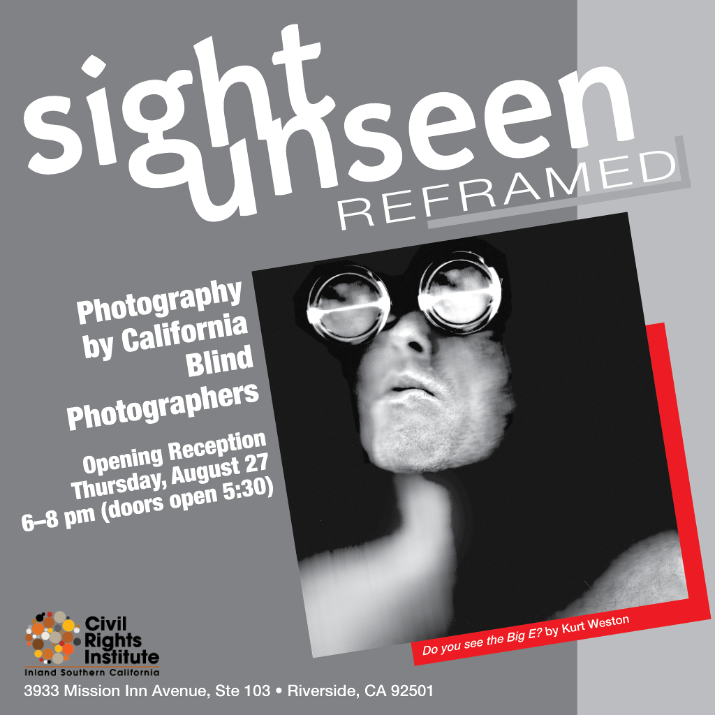
Transcript: Kurt Westen’s recent photographs are soaked in anger, loss, and the stigma of disease and decay, and the artist is pretty happy with the results. “I not only want to look at these things, photograph these things, but put an exclamation point on them,” Westen says. “I’m saying you need to look at this disabled body, this aging body. Maybe you need to reconsider your ideas about what is normal or abnormal. You need to look, and I’m gonna make you look.” “Being considered the other has always driven my art,” says Weston. “First being gay, then having AIDS, and now being blind, it’s been like a journey into otherness. A lot of my work aims to show that all of us are the other. We all have the other in us. We are all headed toward decay and disability.” Weston is a participant photographer in the world of the stigmatized, the grotesque. Weston has produced a powerful participatory document from a marginalized world, in the same way that Larry Clark brought us the troubled teens of Tulsa and Nan Gold in the heart-shaped bruises of 1980s New York. The artist is no voyeur. These are insiders’ reports. “I am the stigmatized person,” says Weston. “I am The Disabled Body. I’ve walked through the supermarket covered in purple Kaposi’s sarcoma lesions, and I’ve seen the people stare. Now I’m blind, and I hold onto my partner, and I feel the people staring.” Weston’s blind self-portraits are a private journal of disability put on public display. “In this blind vision series, I try to capture some of the edge, some of the hard reality of how I became blind.” In 1991, Weston was diagnosed with AIDS, and by 1996, his eyesight spiraled into blindness from opportunistic cytomegalovirus. He is totally blind in his left eye. Very slight peripheral vision remains in his right eye. “In these photographs, I turn myself into an object, a stigmatized object. I try to make myself look inhuman, grotesque. They may be hard, but we’re dealing with a life-threatening terminal illness, with people being cheated out of their lives, out of there sight.” Weston’s newest work on aging, Hearts of a Silent Age, manages the nifty trick of respectfully rifling through other people’s diaries, of reverentially revealing their flesh and their secrets. Longevity is a natural subject for an artist whose own lifespan inevitably will be curtailed by AIDS. Threat and decay is Weston’s daily world. It’s been a bitter battle just to stay in this world, so he’s not about to flinch now or look away. “These photographs are about the realization of loss, about losing your facade. They say, ‘This is your new reality. This is your strange new flesh. Let’s take a look.'” The artist’s use of a scanner as camera gives his work an overtone of hyper-realism and immediacy. There is no space between capture device and subject. No intervening air, no subterfuge, no escape. Instead, the amplified details of flesh and fabric are in direct contact with the scanner’s glass membrane. Appropriately, too, for Weston’s concerns, scanners involve duration. There is no shutter click. Instead, subjects face the long, slow travel of the scanner bar, an extended, indecisive moment. Additionally, flatbed scanners have a very shallow depth of field, commonly half an inch or less. Flesh against the glass is inhumanly vivid and detailed. But anything more remote fades quickly into blur and black. Before he became blind and came to California to die, Kurt Weston worked as a fashion photographer in Chicago. Quote: “I toiled in the artifice factory,” he summarizes. Since becoming blind, Weston has earned an MFA in photography studying with Eileen Cowan at California State University Fullerton and has exhibited work across the country, including the Berkeley Art Museum, Philadelphia Museum of Art, and Kennedy Center for the Performing Arts in New York. Quote: “I guess it’s God’s little joke, having someone who is legally blind do so well in the visual arts.”
Alice Wingwall (1935 - 2026)
Listen to McCulloh read Wingwall’s biography
Transcript: Wingwell’s images look like they’re constructed of photographs, but the primary building blocks are actually memory. “My vision comes from putting a lot of images together, and that comes from the memory, a long time of memory,” says Wingwall. “I think there’s a whole history, many, many years of seeing and analyzing, looking at architecture, being an architectural history major, then moving into sculpture and photography. I think I’ve stored up a lot of images.” Wingwall holds an MFA in sculpture from UC Berkeley and was director of the studio arts program and professor of sculpture at Wellesley College in Massachusetts. Perhaps her decades-long descent into darkness from retinitis pigmentosa gave special impetus to her collection of the world as images. Now, completely blind, Wingwall is the archivist of a private memory museum. The West Coast photographers of the F-64 group, Edward Weston and Admiral Adams most notably, founded their photographic practice on clarity and the notion of pre-visualization, fully imagining the final image before releasing the shutter. Wingwall, a resident of the Bay Area, extends this ethos. Starting with her visual memory bank, Wingwall builds images in her mind, shuffling and resorting imagining possibilities. “It seems crazy, but I think I imagine more than somebody else who is fully sighted.” Then she shoots, gathering images that she cannot see, but these elements are less final art than raw material. Wingwall continues by internalizing reports of the images, adding traces of traces to her mental library, and begins her internal image building anew, imagining possibilities. Only after combining, reordering, re-imagining, does Wingwall release a work into the world of the sighted. “Though I’ve lost my sight, I haven’t lost my vision,” summarizes Wingwall, “and vision is a mental construction,” end quote. This artist’s inside out pathway leaves traces in her work. Photographs are always, to a considerable extent, about the frame, the shadow of the camera. In Wingwall’s images, objects jostle against the limits of the frame, assign their place through happenstance rather than control, and her embrace of multi-image composites and sequences lets the frames themselves multiply and move out into a more sculptural space. To a considerable extent, Wingwall’s blindness and resulting visual freedom enhance her natural predisposition to move beyond the frame. In addition, Wingwell sees her photography as a political act. For a blind person, making a photograph is a choice, a radical move, a political move. With her photographs, Wingwall lays claim to the visual world, even if she can’t see. “I was tired of people saying to me, ‘How can you take a photograph when you can’t see anything?’ And I think they weren’t asking me, they were telling me, ‘How can you do this? It’s unthinkable.’ Well, I can do it. What I say to them is that the image starts in the brain.”